There is a saying among tailors that a man is judged first by his shoes. It is not quite true, but it is close. A good shoe does a great deal of quiet work: it grounds a silhouette, sets the tone for everything above it, and — more practically — carries the full weight of the body across the day. A bad shoe does the opposite, and it does it faster than almost any other garment.
The case for considered footwear is not a case against sneakers or against fashion. It is a case against disposable construction, and for a small number of shoes built to be repaired, re-soled, and worn for a decade — see our shoes collection for examples.
What 'better' means
A well-made shoe is defined less by its brand than by its construction. The single most important question is how the upper is attached to the sole. The three methods you will encounter:
- Goodyear welt. A strip of leather — the welt — is sewn to the upper and the insole, and the sole is then sewn to the welt. The result is a shoe that can be re-soled repeatedly without touching the upper. Read more on the Goodyear welt. It is the gold standard for longevity.
- Blake stitch. The sole is sewn directly through the insole and the upper. Sleeker and more flexible than a welted shoe, but harder to re-sole and less water-resistant.
- Cemented. The sole is glued to the upper. It cannot be re-soled and will not last. It is the construction of almost every shoe under a certain price.
A considered shoe is, almost without exception, a welted or Blake-stitched one.
Building a small, complete collection
Most wardrobes need fewer shoes than they contain. The shape of a complete, considered collection:
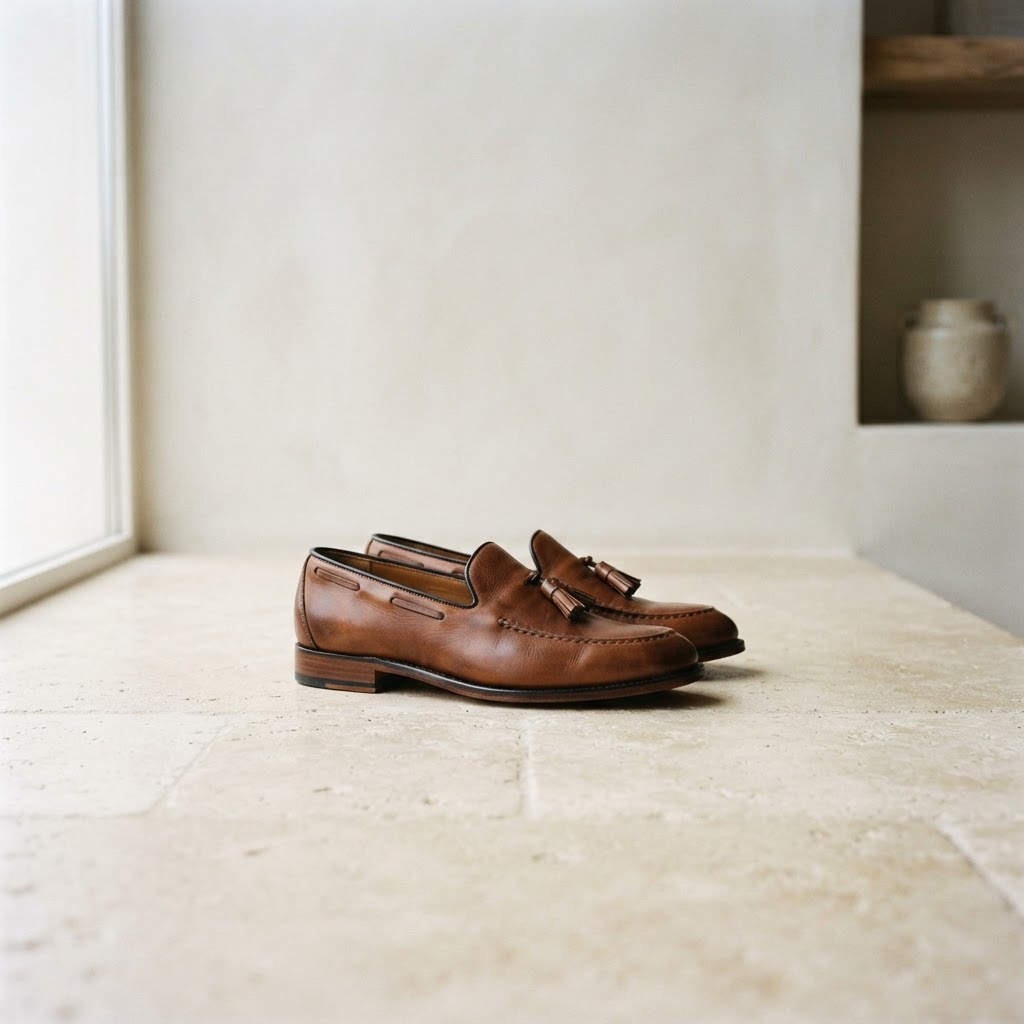
- One leather lace-up or loafer. Brown, oxblood, or black, in that order of versatility. The shoe that carries a tailored trouser and a dark denim equally.
- One cleaner sneaker. Leather or a single-colour suede, free of logos. The shoe that eases a knit and a trouser into the weekend.
- One seasonal shoe. A desert boot for the heat, a brogue for the cold, a penny loafer for the months between.
Three shoes, each with a clear role, each of a quality to be kept rather than replaced. That is a complete footwear wardrobe.
Care as part of the purchase
A good shoe is only as good as the care it receives. A few habits make the difference between a shoe that lasts three years and one that lasts ten:
- Use shoe trees. Cedar trees absorb moisture and hold the shape of the upper between wears. They are the single highest-return accessory in a wardrobe.
- Rest them. Never wear the same leather shoe two days running. Leather needs twenty-four hours to release the moisture it has absorbed.
- Polish, condition, and protect. A cream polish nourishes the leather; a wax builds the finish. Rotate between them.
- Re-sole before you must. A welted shoe worn past the point of its first sole damages the welt and shortens the shoe's total life.
Why it matters
Footwear is where the idea of 'buy once, wear well' is most clearly true. A welted leather shoe, cared for, will outlast three or four cemented ones and will look better in its fifth year than in its first. It costs more at the point of purchase and less over the life of the object. The case for considered footwear is, in the end, a small piece of a larger argument — that the things we wear closest to the ground deserve the most thought.
Further reading
- Goodyear welt — Wikipedia — the construction in detail.
- Complex — Jaden Smith at Christian Louboutin — a new chapter for men's footwear.